
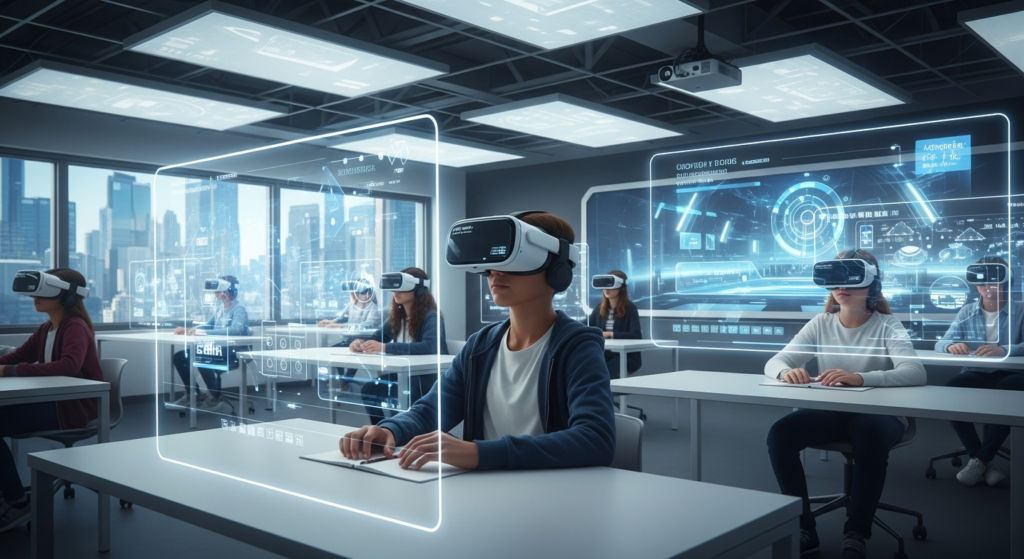

The metaverse and virtual reality (VR) technologies have shaped a phenomenal change in the educational environment. Physical classrooms are transforming into totally new forms of digital classrooms where students can learn, communicate, and collaborate in all new forms of ways. Virtual reality is no longer a gaming or entertainment tool but it is an effective education tool as it provides students with practical experiences, interactive learning, and universal connectivity.
The transition to metaverse classrooms is motivated by the necessity to increase student engagement and improve retention rates and make learning a more active and interactive process. With the help of VR, teachers can give the students some experience that they could not or could not do in real life, and turn some abstract knowledge into concrete knowledge.
The emergence of Virtual Reality in Learning.
The last several years have seen great momentum of VR in learning institutions. The main advantage it has is the development of immersive simulations where students can become an active participant in the content. An example is that a student of biology can use 3D models to investigate the internal processes of a human cell and a student of history can tour ancient Rome and a student of physics can perform advanced experiments in a secure virtual laboratory.
VR is immersive, and this allows learners to visualize concepts, play with ideas, and interact with virtual objects in ways that could not be replicated using traditional approaches. Such a practical method fosters interest and promotes critical thinking and understanding.
Key Features of VR Learning
- Immersive Environments: Students are in the learning environment.
- Interactive Learning:Lesson-Lessons are not passively observed, but are actively engaged.
- Collaborative Spaces: Students in various regions are able to collaborate and work.
- Individualized Learning: VR happens to conform to the individual learning pace and style.
This combination creates an opportunity to make otherwise boring lectures an experience that will be remembered and will make people become active participants.
The way Metaverse Classrooms increase the level of student engagement.
Motivation and engagement of students is an issue that has not always been easy in the teaching field. Metaverse classrooms solve this issue because they make learning interesting, engaging, and purposeful. Students do not need to only hear a lecture but play the gamified lessons, solve tasks, or go through virtual worlds based on the curriculum. This virtual reality practice fosters curiosity, exploration and group work.
More so, the metaverse is a source of cross-cultural interactions. International students are able to meet one another in a virtual environment, work together in projects, and get to learn through diversity of views. Educationists will be able to view engagement rates at any given time, monitor the progress and change the lesson to achieve the best possible results and involvement.
Real-Life Applications
A number of schools already use VR in their teaching methodology:
- Virtual Field Trips: Students visit places such as the Louvre Museum or the great wall of china virtually.
- STEM Labs: It is possible to conduct physics, chemistry, and engineering experiments in VR with no harm.
- Language Learning: Immersive environments are useful in helping students learn languages in a natural way by creating a simulated real world.
- Medical Training: Future physicians have the chance to carry out surgical operations or examine the human anatomy in an interactive way.
- History and Geography: Students will be able to study historical occurrences or a geological formation in their entire spatial comprehension.
Such applications demonstrate how VR can enhance learning, as it can help to make a lesson more interesting and effective.
The advantages of Metaverse Classrooms.
The benefits of the application of VR in education are multiple:
- Greater Retention: Immersive experiences are better in memorizing and comprehending.
- Accessibility: VR classrooms allow students with disabilities to engage in classes to the full extent.
- Safe Experimentation: Experiments are risky or expensive to perform, but can be simulated without any real-life implications.
- Improved Motivation: Interactive and Gamified lessons increase motivation towards learning.
- International Cooperation: Students are able to communicate with other students and experts around the globe and broaden horizons.
- Specialized Learning: VR technology powered by AI will be able to adjust the lessons according to personal requirements and development.
The mentioned advantages prove VR to be not a mere fad but a revolutionary instrument of contemporary learning.
Issues and Obstacles.
VR in education has its challenges despite this potential. The VR headsets and other related devices are expensive, which some schools cannot afford. The learning can be disturbed by technical faults, technical failures and software malfunctions. Moreover, educators need to be trained to create successful VR lessons and lead students in the new setting.
The other factor is the health effect. Some learners may feel strained, motion sick or fatigued due to the prolonged use of VR. Schools should strike a balance between the use of VR and conventional teaching and make sure that the students receive frequent breaks.
The Future of Learning
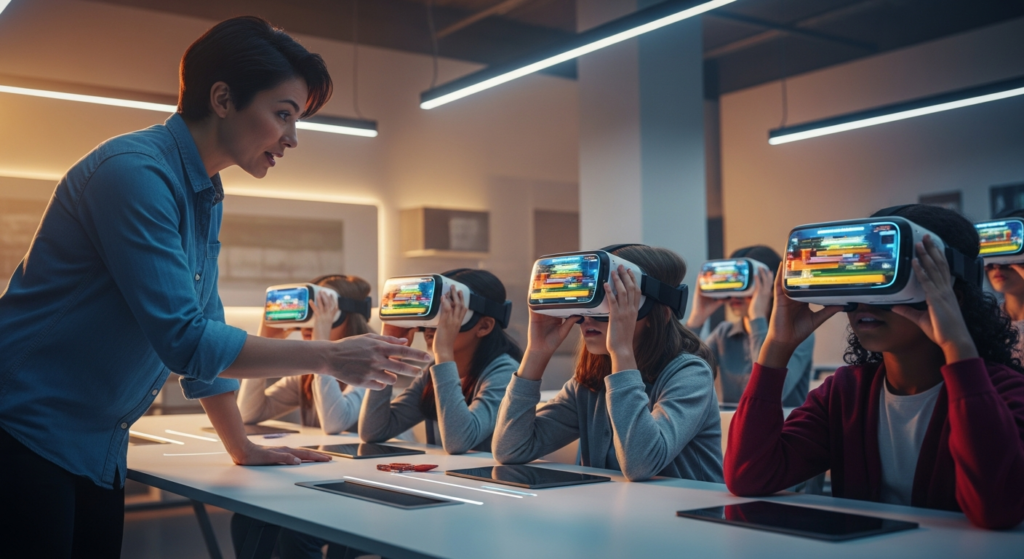
The metaverse is the future of education. With the further development and cost reduction of VR technology, virtual classes will be the norm in schools, colleges, and professional training programs. The meta-verse can offer a spectrum of AI-driven learning spaces that offer highly personalized, adaptive education to students based on their strengths and weaknesses.
Think of a world in which every student will be able to visit Mars in VR, run complex chemistry experiments in a safe place, or work with colleagues in other parts of the world, all using one VR headset. This vision is quickly coming into reality and in the coming decade, the world is going to transform the way we learn and apply knowledge to use.
Conclusion
Metaverse classes are not a far-fetched idea but a reality that is changing the way education is being done today. These classrooms are more interactive through the integration of virtual reality, immersive learning space, and AI-generated personalization, making learning more attractive, interactive, and accessible around the world. Although such obstacles as cost or technical constraints are present, their advantages outnumber them significantly, and provide students with an education that is dynamic, inclusive, and memorable. With the further utilization of VR technology in schools and institutions, the conventional classroom will be changed to a hybrid variant where virtual sessions will be used to supplement physical education to prepare students in a future where digital literacy and embodied knowledge are indispensable.
FAQs
Q1: What does a metaverse classroom mean?
A virtual classroom is a classroom setting that is designed to function as a virtual learning environment where students and teachers communicate and engage with each other through the use of VR technology to mimic real-life education settings.
Q2: What is the effect of VR on student involvement?
VR helps learners to have immersive experiences of learning which happen to be exciting, memorable and hands-on.
Q3: Would metaverse classes become alternative to the normal schools?
As much as they improve education, they add to and not substitute physical classrooms to provide experiences that are otherwise hard to experience.
Q4: Are VR classes appropriate to every subject?
The majority of subjects are beneficial, especially the STEM, history, languages, and arts, although the efficiency relies on the design of the lesson.
Q5: What is required in VR classrooms?
VR equipment needs VR headsets, compatible computers or devices, and specific educational VR software to be used by students.
Share this content: