
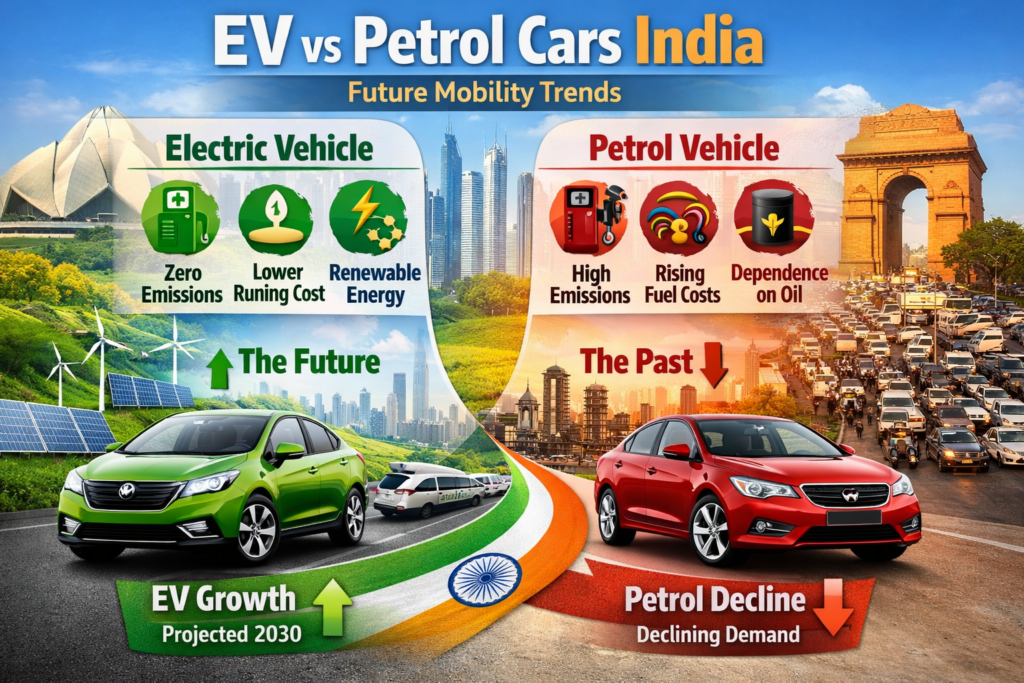

The automobile industry in India is at the crossroads of transformation, with electric vehicles (EVs) and cars powered by petrol competing in terms of consumer preference. As environmental issues intensify, fuel prices rise and rise, and the government’s push towards electrification is strong, it is more pertinent than ever that the debate about EVs vs. petrol be more pertinent. The two segments have been changing fast in 2026, determining the future of mobility in the country.
The electric car revolution in India.
The progress of electric cars in India has been remarkable over the past decade, and electric cars will be stable in the urban markets as early as 2026. The policy support, government programs, and subsidies, as well as tax incentives, have helped the EVs to be more affordable to consumers. In addition, people have moved to natural ones because of the dissemination of information about climate change and pollution.
Improvement in technology is also a fact. Current EV models are now fitted with better battery capacity and higher driving range, and are able to charge more quickly. These advancements have eased the fears regarding performance and practicality, and EVs can be a very good alternative for commuting every day. Moreover, car companies are launching a wide variety of EVs at different prices, which now gives buyers the choice of which to buy based on their requirements and financial abilities.
Gasoline automobiles are still on top.
Although EVs are growing at a rapid rate, in 2026, petrol cars will still dominate the Indian automotive market. Their affordability and accessibility are one of the main factors. At the entry-level petrol level, the cost of electric vehicles is still very high compared to petrol, and thus, first-time buyers are willing to use a petrol vehicle.
The other significant benefit of petrol vehicles is the structure of refueling facilities. There are fuel stations in the urban, semi-urban, and rural areas, making it convenient for the users. Compared to EVs, where there is still a need to build a network of charging stations, petrol cars provide unrestricted mobility, especially when travelling long distances.
There is also the trust that the consumer has. Petrol engines are not new, and their reliability is known. The fear of using newer technologies is making many buyers reluctant to use them, particularly when they have some doubts regarding battery life, resale value, and availability of charge.
Infrastructure Development and Hurdles.
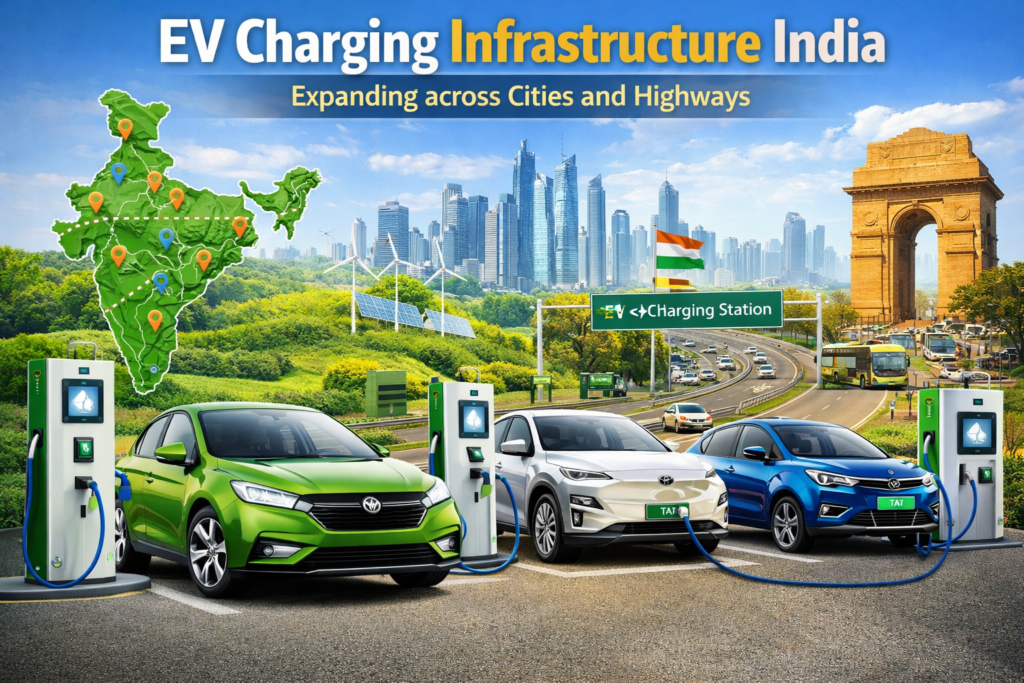
Infrastructure is also one of the most important factors in terms of EV versus petrol in India. The country will have already achieved a lot of development in terms of EV charging networks by 2026. Increasingly, major cities have more and more public charging points, and highways are also equipped with fast-charging points.
Nevertheless, the growth is disproportionate. Though big cities enjoy the advantage of solid infrastructural facilities, small towns and rural areas are still restricted. This difference poses a problem to the large-scale adoption of EVs because the consumers not living in an urban center will struggle to use electric mobility as their only option.
The government and the business world are actively striving to overcome this shortcoming by investing in charging networks and popularizing home charging systems. The convenience aspect of EVs is likely to go up by a notch as the infrastructure keeps on improving.
Experience of Cost and Ownership.
Price is still a decisive factor among the Indian consumers in whether to drive an EV or a petrol car. Electric vehicles are expected to be a more expensive option in 2026 because the technology of batteries is very costly. They, however, provide huge long-term savings by reducing running and maintenance costs.
Electric cars operate using electricity, which is much cheaper than petrol, particularly as the fuel prices are increasing. Moreover, EVs contain fewer mechanical parts, which means that they require less maintenance. In the long term, these advantages are able to compensate for the initial costs, and EVs become more affordable among everyday users.
Alternatively, petrol cars still attract the attention of customers who are ready to pay less and to possess a car at the moment. Nevertheless, their operating costs in the long run, such as fuel and maintenance, are much higher. With increasing awareness of total cost of ownership, the economic benefit of EVs is starting to become more apparent.
Shifting the Consumer Preferences.
The Indian consumer behavior towards electric vehicles is slowly changing to buying the Indian electric vehicles by young and environmentally conscious consumers. Urban clients would have more preference for EVs because of shorter commuting ranges and the availability of charging systems.
Simultaneously, petrol vehicles are still widely used in rural and semi-urban regions, where EVs are still not as feasible due to infrastructure issues and extensive commutes. The fleet operator and ride-sharing service are also adding to the EV development since they have a reduced operation cost and government subsidies.
Buyers are becoming sensitive to brand perception, features of technology, and environmental impact. The more people are aware of the possibility, the more consumers will be ready to talk about electric mobility as the sustainable and future-ready option.
Conclusion
The future of vehicles in India in 2026 is not an easy win for EVs or petrol vehicles, but instead, it is a transitional period when they co-exist. Electric cars are fast becoming popular due to policy backing, technology, and environmental consciousness. Nonetheless, petrol cars still have a very important role to play because they are affordable, reliable, and they have extensive infrastructure.
The proportion will gradually improve with electrification as the nation moves on. Increased adoption will also be achieved with further investment in charging infrastructure, decreasing the price of EVs, and battery technology. At the same time, petrol cars will still be applicable in some spheres, particularly in some regions where infrastructure is not developed yet.
(FAQs).
1. Will EVs be cheaper than petrol cars in 2026?
Yes, EVs will probably be cheaper in the long run because they are less fuel-consuming and they take less maintenance care, but they are more expensive initially.
2. Does India possess a great number of EV charging stations?
Infrastructure in terms of charging has been enhanced much more in urban centers and on highways and is yet to be taken to the rural settings.
3. Are EVs suitable enough in terms of range?
The range of most present-day EVs is suitable to make daily trips, particularly in cities.
4. The question is why petrol-powered cars are still preferred.
The initial cost of petrol cars is cheaper, fuel is readily available, and the car is known to make long distances.
5. Will petrol cars in India have a future?
It is expected that gasoline cars are going to stay in the market over a few years, although their share might decrease due to the widespread adoption of EVs.
Share this content: