
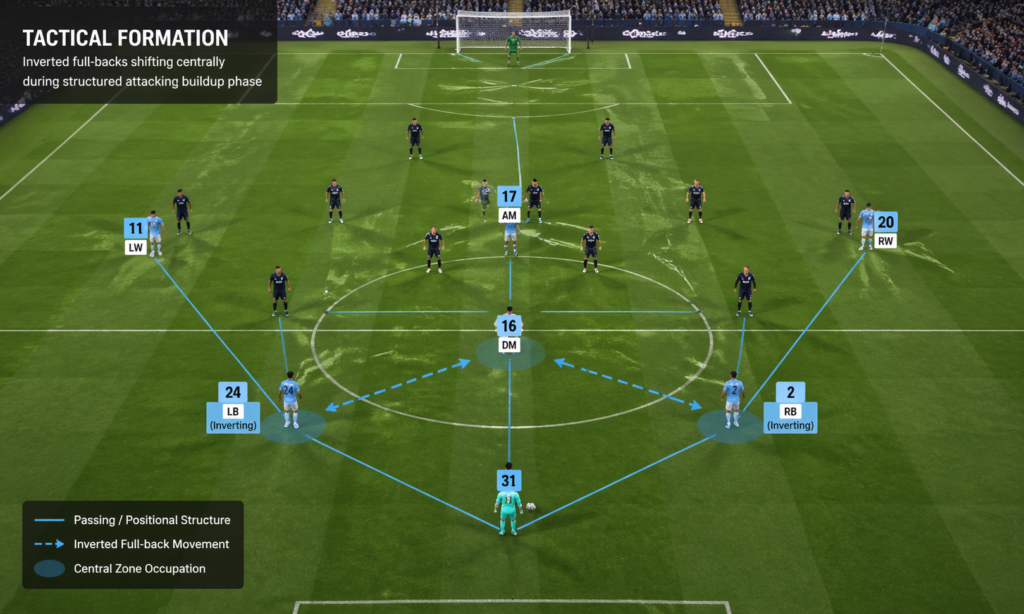

The contemporary Premier League is still reinventing the tactical innovation and the inverted full-back is probably one of the most radical positions in recent years. The full-backs are traditionally confined to defensive roles and overlapping runs, which is why they are currently venturing into the field of midfield, redefining positional play and affecting attack and defense in more intricate ways.
What Is a Full-Back Inverted?
A full-back that turns into a midfielder is an inverted one who moves to central midfield when the ball is being held back. The idea received a lot of publicity during the tenure of Pep Guardiola at Manchester City where positional fluidity was a tactical identity.
Strategic Change of the Role.
It is not merely a tweaking of the position, but a more fundamental shift in the thinking of football. Full-backs have now been required to play as additional midfielders and to assist in the circulation of the ball, manage the pace, and facilitate transitions. The combination of these two factors requires a high level of awareness, technical quality and the ability to make decisions in stress, which is why it is one of the most complicated jobs in modern football.
Inverted Full-Backs Strategic Benefits.
- Forms numerical advantage in midfield areas.
- Increases ball movement in pressures.
- Allows wingers to stay wider and more attacking
- Enhances the structure of football in possession form.
- Makes it difficult to predict patterns of attack.
The ways that Teams can maximize these benefits.
Central areas have been dominated by teams like Arsenal under Mikel Arteta who have used players like Oleksandr Zinchenko. These players can be considered deep-lying playmakers by stepping into the midfield and ensuring control and setting the pace of the games.
The system also enhances spacing between the pitches. The full back is pushed in an inward direction leaving the wide attackers such as Bukayo Saka with more chances to get isolated against the defenders, enhancing the efficiency of the attack.
Strategic Threats and Operational Difficulties.
- Opens up defensive zones in transitions.
- Makes it easier to be counter-attacked.
- Needs a lot of tactical intelligence on the part of players.
- Potentially confounding in the defensive stages.
- Requires great physical stamina.
The reason why this system may backfire.
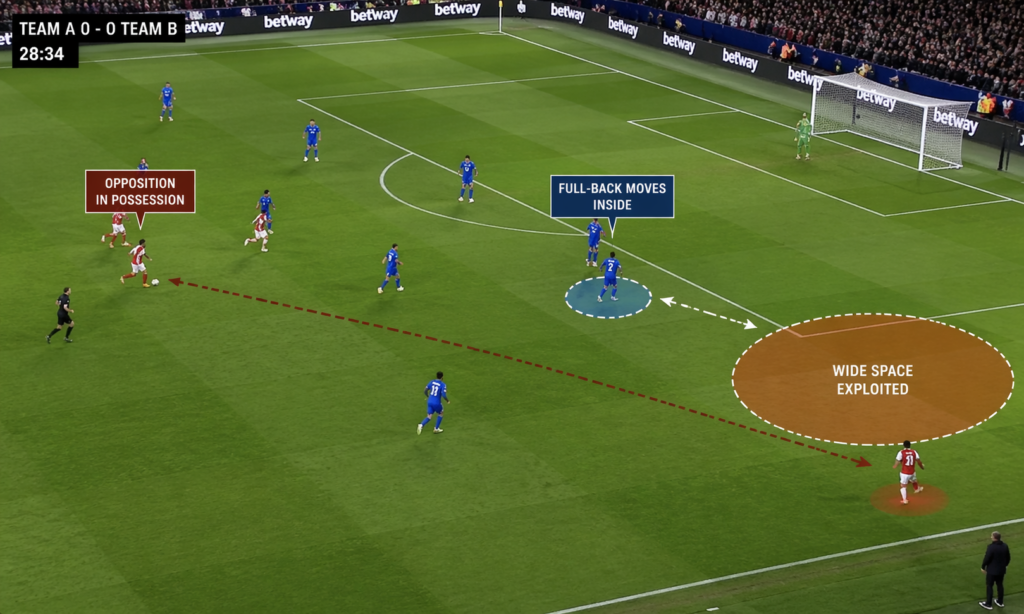
Although it has its strengths, an inverted full-back system may result in structural vulnerabilities. High-speed counter-attacks by Mohamed Salah have helped teams such as Liverpool to exploit such weaknesses under the leadership of Jürgen Klopp.
In instances of possession loss the inverted full-back is usually found off-side, leaving flanking channels open. Opponents may easily change into such spaces causing defensive rearrangements that may result in goal-scoring opportunities.
Strategic differences among Teams.
The inverted full-back, as understood by various teams, will vary with the philosophy of the team. Whereas Manchester City is all about control and positional domination, Arsenal incorporates both control and vertical attacking purpose.
Flexibility, Positionally, in the Contemporary Systems.
Formations in most instances change dynamically at the time of matches. However, a back four can be changed into a three-man formation and the inverted full-back is added to the midfield. This versatility enables the teams to respond to various stages of the game and to maintain the balance and give maximum attacking production.
Skillset needed by the player in the position.
Not all full-backs are able to fit in this system. The position requires a particular kind of quality that transcends conventional defending.
Technical and Mental requirements.
Players need to have excellent ball control, passing, and spatial awareness. They must read the game as midfielders with maintenance of defensive discipline. The speed of decision-making plays a vital role, and any central area’s hesitation may result in turnovers and direct threats.
Moreover, communication is also essential. With midfielders and center-backs, coordination of movements will keep the team intact even in transitioning.
The Future of The Inverted Full-Back Position.
The inverted full-back is not merely a fad as it indicates the overall change of football into positional versatility and tactical smartness.
Long-Term Tactical Impact
With the growing use of possession-based systems by more teams, the need to have versatile players will also rise. The distinction between defenders and midfielders will further blur and the result will be an increase in the number of hybrid positions on the pitch. Young players are already being prepared to fit into a variety of positions and so this concept of tactics will be applicable a few years down the line.
Conclusion
The inverted full-back is an important change in the tactics of football, which has turned a historically defensive position into a playmaking central position. It has obvious benefits in control, as well as flexibility and attacking organization, yet also poses a risk, which can be utilized by well-organized opponents.
After all, its success is in its implementation. Teams that learn to control this system can control games with accuracy and power, and those that do not manage to balance the dangers might not be good defenders. With football still developing, the inverted full-back role will always be a characteristic of the new game.
FAQs
1. Why are inverted full-backs different to conventional full-backs?
Inverted full-backs occupy central midfield positions when the ball is in possession and traditional full-backs are mostly found on the flanks and are concerned with making overlaps and defensive coverage.
2. Who were the managers who popularized this tactic?
Inverted full-back Pep Guardiola and Mikel Arteta managers were significant contributors to the system gaining popularity and perfecting the inverted full-back system in modern football.
3. What is the reasoning behind this strategy in the game of football today?
It boosts possession in the middlefield, builds-up play and spacing of players in attack, making teams more powerful in possession.
4. What is the largest weakness of this system?
Exposure on broad fronts and susceptibility to rapid retaliatory attacks in case of a loss of possession are the key weakness factors.
5. Will this strategy be applicable to every team?
Not necessarily. It involves players that are well trained in technical aspects and good tactical knowledge, which is more applicable in the elite, well coached teams.
Share this content: